


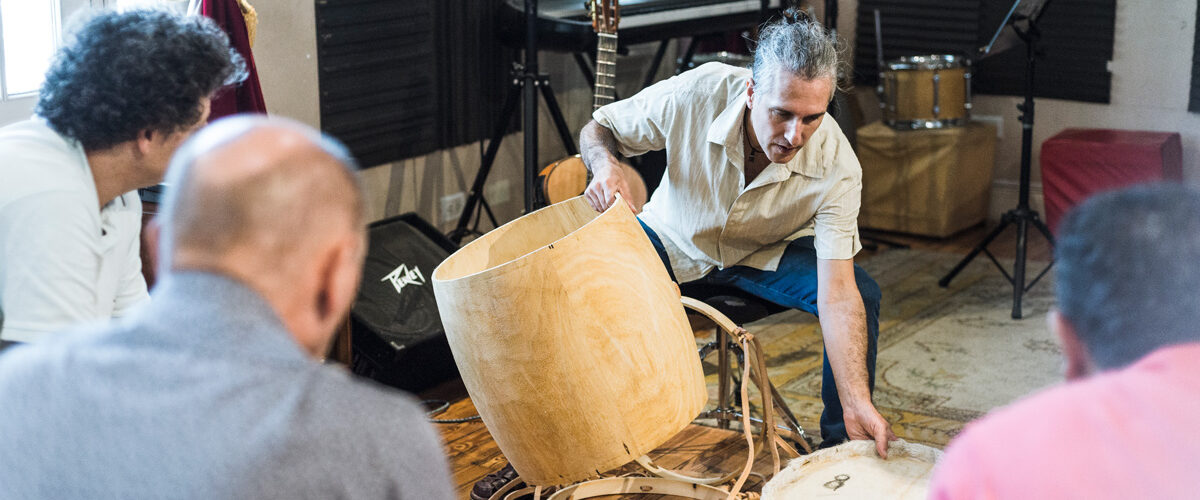
Why is it called a ‘bombo legüero’?
The ‘bombo legüero’ owes its name to the impressive ability of its sound to be heard over long distances.
The term ‘legüero’ derives directly from the word ‘legua’ (a unit of measurement equivalent to around 5 kilometres). It is so named because, according to popular tradition, the deep rumble of its drumhead and wooden body can be heard from more than a legua away.
This characteristic is no coincidence, but rather the result of its handcrafted construction and the materials used to make it:
- The shell (body): This is produced by hollowing out a whole tree trunk (usually ceibo, quebracho blanco or palo borracho). Ceibo wood, in particular, is porous and light, which gives it a deep and impeccable resonance.
- The skins: Animal hides (usually from sheep, goats or guanacos) are used, retaining their natural hair. The hair dampens the high frequencies and enhances the low frequencies, allowing the sound to travel across open spaces without losing its power.
In rural areas of northern and central Argentina, such as the province of Santiago del Estero, the bombo legüero was not only used to accompany music (such as the chacarera and the zamba), but also as a means of communication. It served to announce the arrival of visitors, summon people from neighbouring fields, signal a festival or warn of danger in times when there were no other means of rapid communication.
Where are the bombos legüero made?
The birthplace and main centre of production for the bombo legüero is the province of Santiago del Estero, Argentina, particularly the provincial capital and the city of La Banda. Although there are now instrument makers who craft them in various regions of the NOA (North-West Argentina) such as Salta, Tucumán and Córdoba, as well as in Buenos Aires, Santiago del Estero remains the historical and cultural epicentre of this craft.
What is the origin of the bombo legüero?
The bombo legüero is the result of a cultural fusion between European traditions and the customs of inland Argentina (with particularly deep roots in the province of Santiago del Estero) during the colonial period. Its historical evolution can be traced back to three key factors:
- The influence of the European military snare drum
During the era of conquest and colonisation, the Spanish armies brought with them military drums and snare drums used in parades. These instruments utilised a system of leather tension straps (tientos) and hoops to tune the drumheads. The Creole and Indigenous inhabitants of the Argentine territory adopted this basic structure and adapted it using the indigenous techniques and materials available to them. - Making use of local flora and fauna
In the Chaco and Santiago del Estero regions, craftsmen replaced European assembled boards with whole logs of ceibo or white quebracho, felled directly from the forest. Hollowing out a single log gave the body a distinctive solidity and resonance. Furthermore, as they lacked the European industrial processes for cleaning and treating hides, they left the goatskin and sheepskin with their natural hair intact. This ‘imperfect’ detail ultimately defined its sound: the hair absorbs the high frequencies and produces the deep bass that characterises it. - From a means of communication to a musical symbol
Before establishing itself as the rhythmic driving force of folklore (in genres such as the chacarera, the gato, the zamba and the malambo), the bombo originated from a practical need in the countryside:- Communication and signalling: In the countryside of Santiago del Estero and the rural areas of north-western Argentina (NOA), the great distances between settlements made it necessary to have a means of rapid communication for gatherings, festivals, emergencies or alerts.
- Measuring boundaries (Mensura): Traditionally, the extent of certain plots of land belonging to neighbouring farms was demarcated by the distance over which the rumble of a bombo drum beaten vigorously could be heard under favourable conditions.
With the popularisation of regional music throughout the 20th century, the ‘bombo legüero’ evolved from being a tool of the bush to becoming the membranophone par excellence of Argentine folk identity.
What is the difference between a ‘bombo legüero’ and a ‘bombo criollo’?
The main difference lies in the fact that ‘bombo criollo’ is a generic term for the family of folk drums developed in the region, whilst the ‘bombo legüero’ is a specific type with construction and volume specifications designed to achieve a greater sound range.
In everyday speech, the terms are often used interchangeably, but technically they have very distinct differences in terms of their characteristics and construction.
Technical comparison
| Characteristic | Bombo Legüero | Bombo Criollo (Standard / Generic) |
| Body construction | Single-piece shell (carved from a single whole log, usually ceibo). | May be single-piece, but can also be made from plywood, multi-laminated plywood or assembled staves |
| Skins | Natural-haired hides (kid, sheep or guanaco) that filter out high frequencies. | Tanned, hairless hides or thinner synthetic/processed skins. |
| Sound | Deep, dry bass with great projection (hence its name, ‘can be heard for leagues’). | Sound with a higher proportion of mid/high frequencies and lower volume. |
| Weight and sturdiness | Heavier and stiffer due to the thickness and volume of the hollowed-out log. | Lighter, ideal for frequent transport or academic/orchestral use. |
| Traditional use | Rural folk music, outdoor marches, traditional ensembles from Santiago del Estero. | Accompaniment in indoor venues, performance ensembles or studio work. |
How many types of bombo are there?
There is no single, strict classification for the bombo legüero, but in instrument-making and musical practice they are categorised according to three main criteria: construction method, size (diameter) and contemporary variations.
1. According to construction and instrument-making
- Traditional legüero bass drum (luthier-made / professional):
- Shell: Crafted from a single, whole ceibo (or white quebracho) log, hand-hollowed (monoxyl body).
- Skins: Natural hair-on hides (often a combination of goat and sheep).
- Sound: Acoustically deep, resonant and highly durable.
- Standard criollo bass drum (commercial or studio):
- Shell: Made from plywood or laminated wood (such as guatambú or cedrillo).
- Skins: Thinner or treated hides.
- Sound: Lighter in weight and cost, ideal for beginners or for frequent transport.
2. Depending on the size and diameter of the patch
The dimensions determine both the tuning (lower notes that are higher-pitched or more resonant) and the player’s comfort:
| Classification | Approximate diameter | Typical use |
| Small | 30 – 33 cm | Students, children or players seeking greater manoeuvrability. |
| Medium | 35 – 37 cm | El estándar versátil para ensamble y práctica cotidiana. |
| Large / Professional | 38 – 43 cm | The size preferred by professional drummers for its balance between bass and body. |
| Extra Large / XL | 44 cm and above | Maximum acoustic projection for stage performances or outdoor shows. |
3. Contemporary designs
Compact legüero bass drum (or ‘travel legüero’): A modern variant designed with a flattened body (8 to 15 cm high). It retains the wooden hoop, traditional straps and skins, but takes up a fraction of the space, making it highly prized by percussionists who travel frequently.




Add comment